
Blum Hinges Explained: Which Kitchen Hinge Do You Need?
Blum hinges explained in plain English: full overlay, half overlay or inset, opening angles, fixings, mounting plates and door thickness, so you can order the right replacement hinge first time.
A cupboard door that drops, sticks out or slams shut usually needs a new hinge, not a new kitchen. Blum hinges are fitted in a huge number of UK kitchens, and they are easy to replace once you know which one you have. This guide explains the different Blum hinges, what the names mean and how to choose the right one, so you order the correct hinge first time.
What is a Blum CLIP top BLUMOTION hinge?
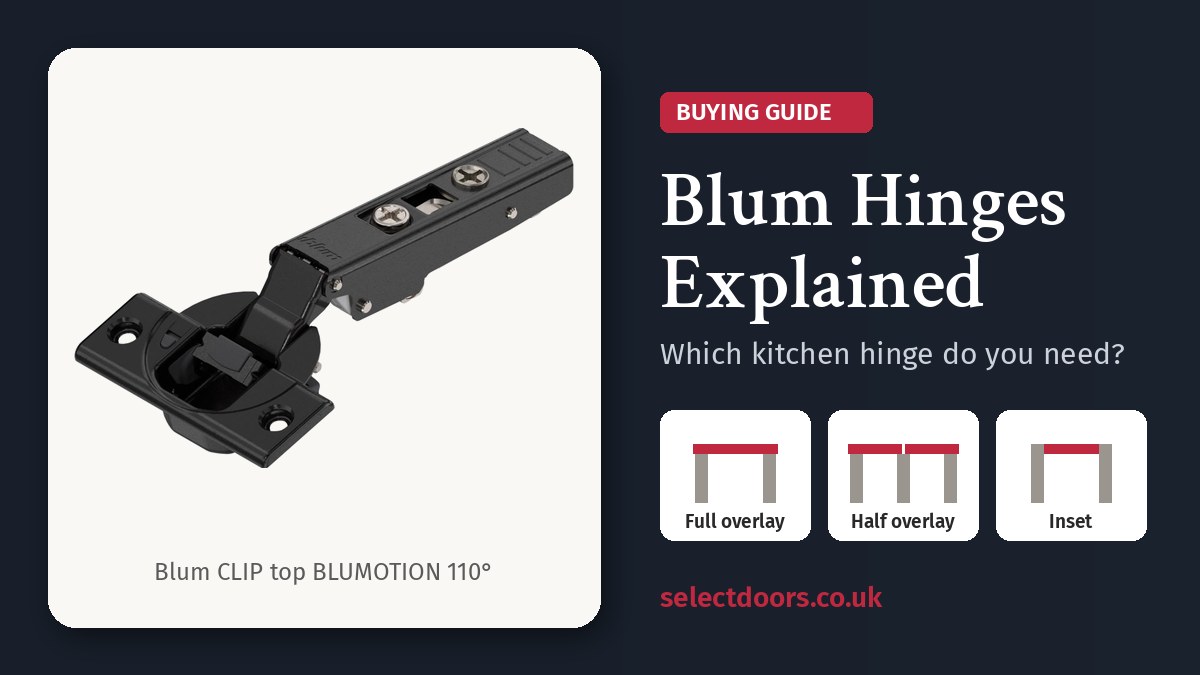
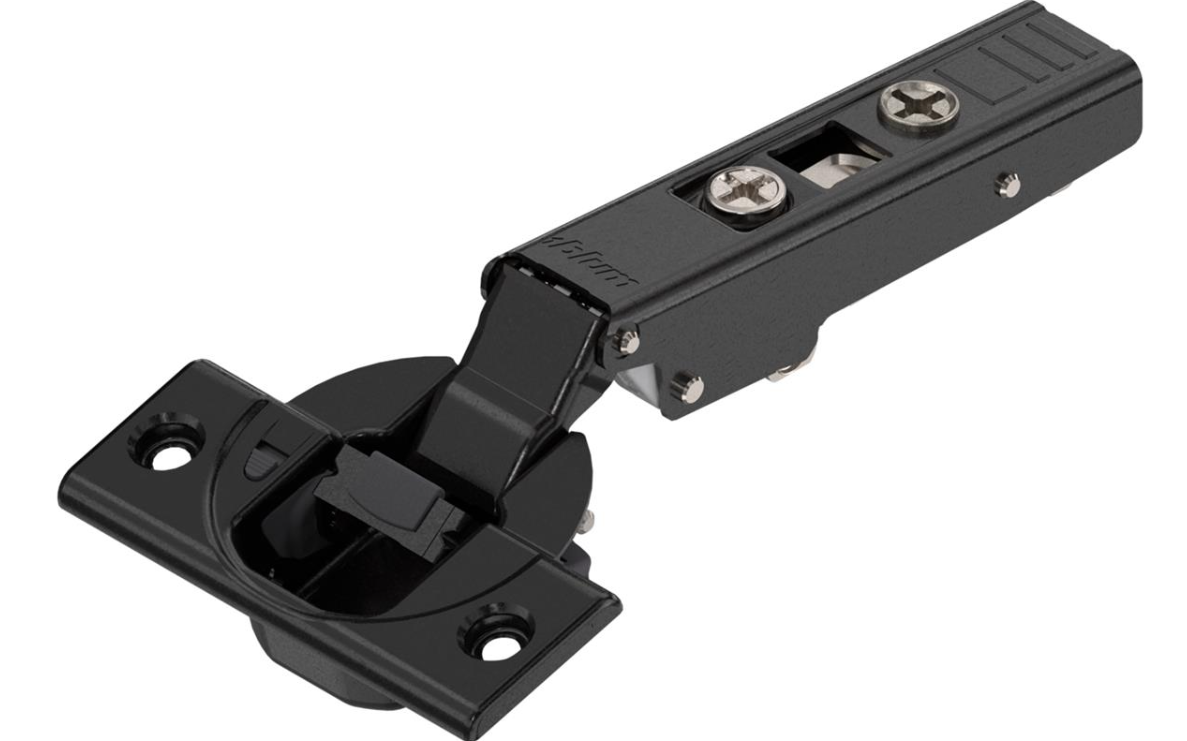
Most modern Blum kitchen hinges are CLIP top BLUMOTION hinges. Each part of the name tells you something:
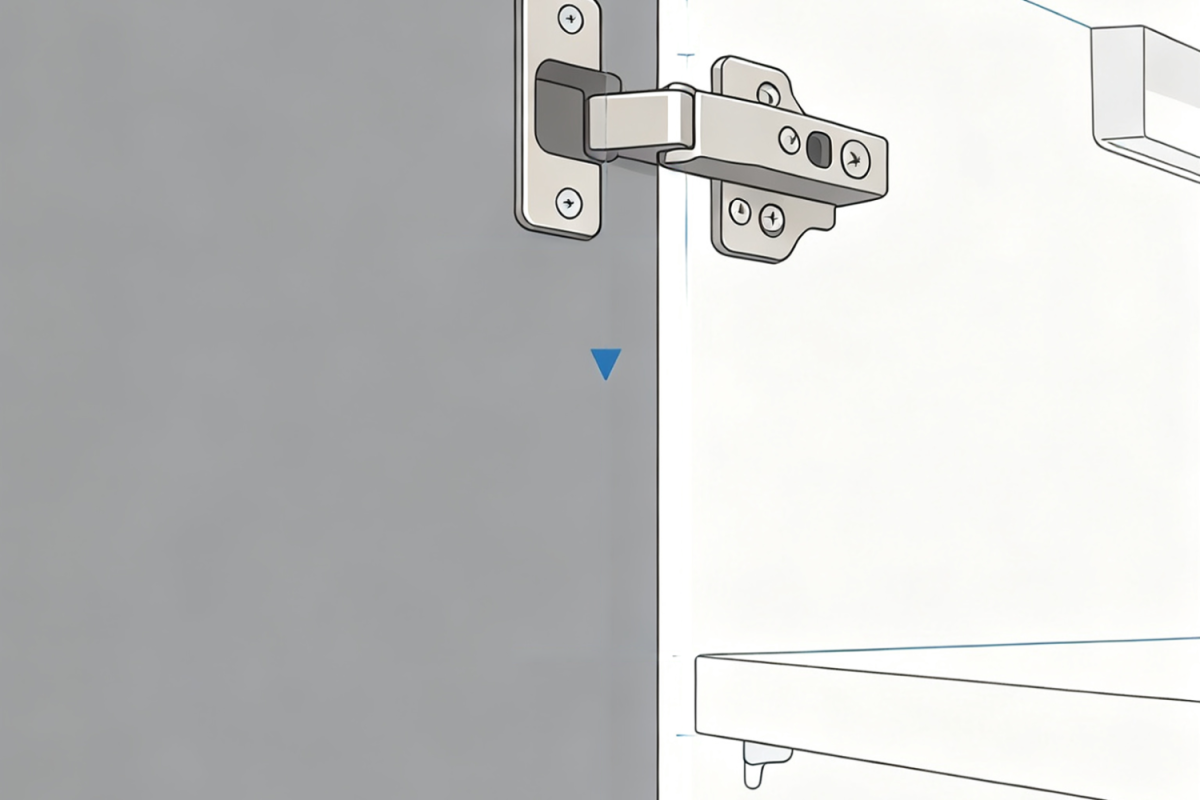
- Concealed hinge: the hinge is hidden inside the cupboard. Its round cup sits in a 35mm hole drilled in the back of the door.
- CLIP top: the hinge clips onto a mounting plate screwed to the side of the cabinet. You can take a door off and put it back without tools, which makes fitting and cleaning easier.
- BLUMOTION: the soft-close damper is built into the hinge cup, so the door closes gently and quietly without a separate add-on.
- Adjustable: once fitted, you can move the door up and down, left and right, and in and out with a screwdriver, so the gaps between doors line up neatly.
Blum also makes hinges without soft close. These are sprung, so they pull the door shut. If your old hinges have no damper and you want soft close, choose a BLUMOTION hinge.
Full overlay, half overlay or inset: which hinge arm do you need?
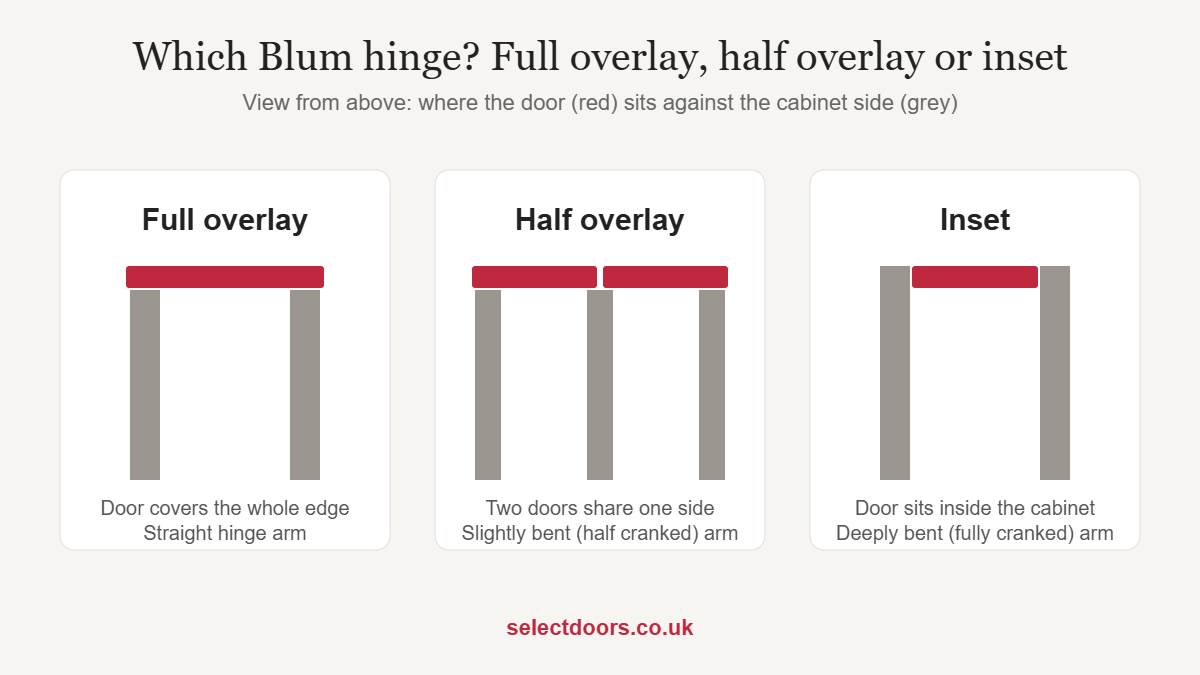
This is the most important choice, and the one most people get wrong. It depends on where the door sits against the cabinet side, not on the door itself.
| Type | Where the door sits | Hinge arm | Typical use |
|---|---|---|---|
| Full overlay | The door covers the whole front edge of the cabinet side | Straight arm | Most kitchen doors, at the end of a run or next to a wall |
| Half overlay (half cranked) | Two doors share one cabinet side, each covering half of it | Arm with a small bend | Two doors either side of a single cabinet panel |
| Inset (fully cranked) | The door sits inside the cabinet, flush with the front | Arm with a deep bend | In-frame or inset kitchens |
How to tell what you have: open the door and look at the side of the cabinet. If the closed door covers the whole edge, you need full overlay. If it covers only half because another door shares that panel, you need half overlay. If the door sits inside the frame, you need inset. You can also compare the arm of your old hinge with the descriptions above.
At Select Doors, the hinge names say which type they are, for example "110° clip top hinge with built in blumotion" (full overlay), "half cranked" or "fully cranked".
Opening angles and special hinges
The number in a hinge's name, such as 110°, is how far the door opens. Most kitchen doors use a 110° hinge. Choose a different angle when the cabinet needs it:
- 95° to 107°: for doors that should not open far, for example where a door would hit a wall or a handle next to it.
- 110°: the standard hinge for most base and wall cabinets.
- 155° zero protrusion: opens wide, and the door stays clear of the cabinet opening. Use it where pull-out baskets or internal drawers must slide out past the open door.
- 170°: opens almost flat against the next cabinet, for full access to corner and larder cupboards.
- Blind corner (95°): for a corner cabinet where the door sits next to another door or a filler panel.
- Angled hinges (+45°, +30°, -15°, -45°): for angled or diagonal corner cabinets, where the door is not square to the cabinet side.
- Bi-fold (60°): for a pair of doors that fold together, such as on a corner unit.
If you are replacing a hinge, match the angle of the old one. If you are not sure, a 110° hinge is the usual choice for a standard cupboard.
How the hinge fixes to the door
The hinge cup can be fixed into the 35mm hole in four ways. Match your old hinge, or choose the one that suits your tools:
- Screw-on: two small screws either side of the cup. The easiest to fit at home with a screwdriver.
- Knock-in (press-in): dowels on the cup are tapped into pre-drilled holes. Quick, but best for doors already drilled for it.
- INSERTA: expanding dowels that lock in by hand, with no screws. Needs the matching holes either side of the cup.
- EXPANDO: pre-fitted expanding dowels tightened with a screwdriver.
Mounting plates
The hinge clips onto a mounting plate, which is screwed to the inside of the cabinet side. Plates are sold separately, so check you have them when you order. The plate's spacing (for example 0mm or 3mm) moves the door slightly further from or closer to the cabinet. If you are replacing only the hinge, keep your existing plate if it is a Blum CLIP plate in good condition, and order a hinge that clips onto it.
Door thickness
Standard Blum 110° BLUMOTION hinges suit most kitchen doors, including our 18mm Vivo slab doors and 22mm Lucente handleless doors. For extra-thick doors, such as some solid timber or framed doors, use a thick door hinge (95°), which is designed for the deeper door.
How to replace an old Blum hinge
- Check the hinge type. Open the door and look at the arm: straight (full overlay), slightly bent (half overlay) or deeply bent (inset). Note the opening angle, and whether it is soft close.
- Unclip the door. Hold the door, press the release at the back of the hinge arm and lift it off the mounting plate.
- Remove the old hinge from the door: undo the screws, or lever out knock-in dowels.
- Fit the new hinge into the same 35mm hole, fixing it the same way as the old one.
- Clip the door back on and adjust it so the gaps match the doors next to it.
New doors? We can drill the hinge holes
If you are ordering new doors from Select Doors, we can drill the hinge holes for you for £3.50 per door. Measure from the top edge of your old door to the centre of the top hinge hole, and from the bottom edge to the centre of the bottom one, and give us those positions when you order. Our guide to measuring replacement kitchen doors shows how.
Frequently asked questions
Are Blum hinges a standard size?
Most Blum concealed hinges use a 35mm cup, which is the usual size in UK kitchens. The arm type and opening angle still need to match your cabinet.
Can I add soft close to my old hinges?
Yes: the simplest way is to replace them with BLUMOTION hinges, which have soft close built in.
Do I need new mounting plates?
Not always. If your plates are Blum CLIP plates in good condition, the new CLIP top hinge clips straight on.
How many hinges does a door need?
Most standard base and wall doors use two. Tall doors, such as larder doors, need more.
Why does my door not line up after fitting?
Use the adjustment screws on the hinge to move the door up, down, sideways or in and out until the gaps match.
Shop Blum hinges at Select Doors
Browse our full range of Blum hinges, including soft-close, wide-angle, blind corner and angled hinges, plus mounting plates and cover caps, or see all hinges. Hinges, handles and accessories are delivered in 1–3 working days: £4.95, or free on orders over £50. Need new doors too? See our replacement kitchen doors.